When I first moved to Asheville, one thing I told myself I was going to do was to jump into the—what I’d read to be, at least—vibrant writing community the city and its surrounding Western North Carolina environs fostered.
Credit where credit is due, I didn’t waste any time. I went to see a famous author speak (with middling results), decided to stretch my skillset by signing up for a flash fiction course, and found a writer’s meetup in West Ashville comprised of other 20-30-somethings pursuing writing careers on top of their day jobs.
The writing group came first, and as someone who struggled with imposter syndrome in terms of writing for a long time, I was excited to finally start pursuing it in a way that wasn’t just mostly internal. That is to say, I went to this meeting with no trepidation, no nervousness, just excitement.
There were 8-10 other writers at a West Asheville coffee shop that shall remain nameless and that this experience, unfortunately, means I haven’t returned to (but to be honest, it’s mainly because kind of a hike for me and the parking situation sucks, over this particular—spoiler alert—awful experience).
To start, we went around the room and shared our “credentials,” which probably should’ve been my first sign that this experience wouldn’t be what I wanted it to be. I’m all for sharing my writing experience or philosophy—we did that at the beginning of the hugely positive class I took, which I’ll get to eventually and which is the crux of this post—but once the term “credentials” gets tossed out, it becomes—in my experience, at least—something of a dick-measuring contest utilizing frankly, outdated and subjective criteria. Like most industries, the world of writing isn’t necessarily meritorious, and often, it’s connections and privilege that afford many writers agents and Booker Prizes rather than skill and passion. Keep in mind that this is also my subjective, shoulder-chipped take.
Now, after all that, I’m definitely not here to rate others’ credentials, but for the point of this story, let’s just say that the highest heights my fellow writers heightened were small-press Chapbooks, which is an accomplishment to be proud of, sure, but this wasn’t a room full of New York Times bylines, ya know?
When it came time for me to introduce myself, I explained that while I was hoping to work on my essays and fiction pieces, I wrote for a living. I’d been blogging consistently for over ten years and was a content writer for my day job. Before I could say that I did have a couple of short stories published in some obscure lit magazines as well, the moderator cut me off, saying—and maybe I just remember it this way—snidely, “Oh, so you’re a copywriter. Most of your writing is advertisements?”
Correct, I’m sure I said (though technically, I’m a content writer…there is a difference).
“No chapbooks?” he asked.
“No,” I said, and I’m still kind of pissed I added this next part instead of defending my very valid writing career that actually paid (and continues to pay) me a livable salary, “but I did have some stories published in small literary magazines.”
“You should have led with that,” he said.
You know what I wish I said?
“Why? Because it makes me a lesser writer to be paid a biweekly salary for utilizing this craft? Because I found a way to monetize my skillset, which makes me enjoy going to work every day? Because when I initially picked my major (English literature and secondary education), I chose one with a built-in career path that meant I wouldn’t have to struggle to make ends meet while writing on the side? Because my lack of trust fund means that I’m unable to cosplay a starving artist while living in a Chicken Alley loft and spending copious amounts of money at The Vault, Double Crown, and Little Jumbo every night (Asheville is filled with “starving” artists who claim to be anarchists and get their rents paid by their parents)? Because I’m the only one here with my bylines on websites that more than 100 people read monthly?”
I didn’t say any of that thought. I’m sure I just smiled and nodded.
On top of it all, the older I get, the more I realize that the various types of writing I do–content writing, copywriting, blogging, fiction, op-eds, and essays—all help inform and strengthen one another. To think otherwise is pretty provincial and sorely lacking in nuance.
Despite that fact (and I’m comfortable saying that take is not subjective), there still exists a massive amount of gatekeeping in the world of writing and the publishing industry over who gets to call themselves a writer, whose work is more legitimate, and what path is the right path to publication (Yellowface is a brilliant satirization of all of this if you’re looking for a good read).
For me, this gatekeeping—and why I think the chip on my shoulder is pretty deep—started in college.
I had a professor we’ll call Dr. F., who I blessedly had for several courses, and who, on my very first day of class with him, made it very clear that pure English Lit majors were more legitimate than English Lit/Secondary Education majors (even though those of us in the latter took double the credits).
“You’re looking to teach, not write,” I remember him saying one time, even though the two aren’t mutually exclusive, and even though he himself made the bulk of his paycheck from teaching, not writing (did my petty ass Google him to see if he had anything of note published? You bet, and I’m happy to report that he’s mostly a teacher).
I remember another time, during a one-on-one conference, he asked if I had any writing ambitions. I told him I did and shared that I wanted to use the summers off teaching would grant me to try and accomplish being the next great American novelist. “Maybe freelance copywriting is what you should pursue,” he said snidely (jokes on him since it’s essentially what I now do… full-time).
I remember thinking at the time that this guy was full of shit…but it still bothered me and made me very self-conscious about calling myself a writer for the longest time.
While teaching, I blogged regularly, wrote several full-fiction manuscripts, and wrote freelance essays. However, I still wouldn’t call myself a writer, not till it was in my job title on my LinkedIn profile. Even then, I would always differentiate that I was a marketing writer, which just goes to show you how ridiculous—but, effective—this gatekeeping is (I ran into the moderator of the aforementioned writing group about a year ago, and this clown said to me “I see you’re writing for the newspaper now,” as if that’s something to be ashamed of).
Anyway, moving onto the less Debbie Downer self-pitying portion of this story.
After the writing group and author talk, I attended that flash fiction writing course I mentioned earlier at the Flatiron Writers Room in West Asheville.
I chose the course because—if you can’t already tell by this piece’s length—I sometimes struggle with brevity. It was given by author Katey Schultz for three hours on a Saturday afternoon, and it was fantastic. The group taking the class was eclectic, and Schultz wasn’t concerned with credentials or bonafide, just chatting with and teaching a group of people who were interested in one of her chosen forms of writing.
I felt like I got a lot out of the course and was eager to sign up for another…but then, just a month and a half after I moved to Asheville—and just a week after the class—a little thing called Covid reared its head and the world shut down.
Flatiron Writers Room held online classes through the pandemic (I attended one…and attended another thrown by a different vendor…but while I think online courses could be extremely useful—I mean, I effectively work fully remotely—sometimes there’s such a thing as too much screentime, so I told myself I’d wait until in-person classes resumed, before attending another. This past spring, they did.
I looked at the offerings and found an online journalism course that called to me, taught by Abigail Ronner. I was immediately interested. Starting to really expand my freelance writing career outside of blogging and op-eds (aka, making some real $) has been something I’ve been telling myself I would prioritize over the past few years, but I had thus far failed to do so. The course felt like a great opportunity, and I was happy to discover that Abby was/is a published writer with some legitimate credentials. I know I scoffed at credentials earlier, but this course aimed to teach one how to pitch and get writing assignments for publications that paid. The fact that she is a working journalist, getting pieces published in publications that still exist—like Harper’s—was important as, too often, these writing courses are taught by authors who had success once upon a time, which isn’t invalid, but the publication world moves at a breakneck pace.
Listen, credentials can be annoying and valid. Two things can be true at once.
Like the flash course from three years back, the group of writers taking this course came from an eclectic background with various reasons for being there. And like Schultz, Ronner came with no ego, not caring about credentials or bonafide (even though, admittedly, I was impressed by hers), adamant that not only could anyone be a writer, but anyone could get paid and published with enough tenacity, technique, skill, and effort.
My class was six weeks long and was more intensive than I anticipated, in a good way. The course isn’t graded or anything, but since I was spending the time and money, I wanted to put forth my greatest effort and do all the suggested readings and activities.
We went through journalistic ethics, how to craft a pitch, and then worked together in class on finding editors and publications for the stories we wanted to write, and workshopped pitches together.
While I got a ton out of the class, what really paid off was the out-of-class time. Abby held office hours at Hi-Wire Brewing on Sundays, where we could go in a more relaxed environment and pick her (and each others’) brain, bringing an extra layer of value to the course.
Once the class was done, I devoted one night a week (slash one weekend morning, if I had them free) to pitching.
My first pitch, a piece on why we need to change how we talk about gun violence, didn’t land anywhere I pitched it. Still, I did get positive responses from Teen Vogue and Glamour, and Abby assured us that even negative responses were good, forward-moving signs (editors get thousands of pitches a day and don’t respond to all).
I started pitching other ideas, and while none stuck, I similarly had meaningful conversations with editors from Vulture, Business Insider, and Rolling Stone, helping boost my confidence and continue pitching.
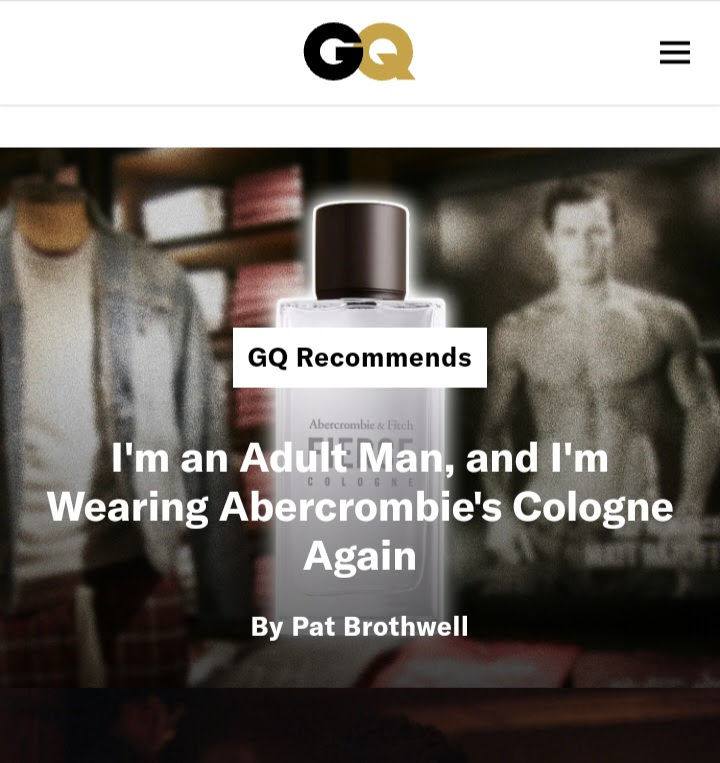
Then, finally, I got a nibble, and it wasn’t about gun violence or Republican hypocrisy or empathies role in politics… it was about my newly resurrected love for Abercrombie and Fitch Fierce cologne…and it was from GQ!
For those who care—and to get a sense of what I was pitching and way—here’s the pitch the Flatiron Writers Room journalism course gave me the skills—and confidence—to put together.
Subject Line: Resurrecting Abercrombie and Fitch Fierce Was the Best Decision I’ve Made in 2023
Hi Avidan,
I remember the sad day I said goodbye to my one-time signature fragrance, which no Polo Black or Calvin Klein Eternity could replicate no matter how hard they or I, tried: Abercrombie and Fitch Fierce. At the time, I was in my early twenties, teaching affluent, antagonistic teenagers why they should care about American Literature, and one day, after coming to my desk to ask for clarification on a test, a girl said to me, “Yum, you smell just like my boyfriend,” in a way I did not like. I ended Fierce’s and my then ten-year relationship. It was for the best, I remember thinking—I was too old (and frankly too cool) to still be shopping at Abercrombie and Fitch. I always felt embarrassed going to retrieve my Fierce as a proper adult, but it smelled so damn good and always got such great feedback.
Fast forward to 2022, and I remember seeing a friend’s knit polo and asking where he got it. “You won’t believe this,” he said, “but Abercrombie.” Being that this was a friend I trusted, I ventured into my local A&F the next time I was at the outlets, and lo and behold, gone were the double popped collars, giant black and white torsos, the double entendre tees that were the pinnacle of style when I peaked in 2003, the faint whiff of self-tanner and the obscene prices. Obviously, as the author of Abercrombie’s $50 Knit Polos Have No Business Being This Good, you both get where I’m going and agree with me.
I’m a recommitted Abercrombie and Fitch devotee—they make great Hawaiian shirts, rugbys, and sweaters on top of those knit polos—but just this year, I decided that now that A&F isn’t cheesy, early-aughts style is officially back, and I no longer have to deal with students who might make me feel creepy, it was time to resurrect Fierce as my signature scent, and I can say with no reservation that it was one of my top choices of 2023.
“Yes,” my good friend commented when I shared my re-commitment to Fierce on my Instagram stories, “you should never have given that up.”
“What are you wearing?” a waitress asked one of the first weekends I Fierce-d about town. “You smell so fucking good.”
I’d like to write a short piece for GQ style with the working title of “You Should Reconsider Fierce,” extolling what a great decision it was to bring back this relic and why it’s the best early aughts throwback for Millennials to embrace.
I’m a marketer and writer living and working in Asheville, North Carolina. I don’t get to write about anything nearly as sexy as you for my day job since I work for an HR SaaS company but am a prolific political op-ed writer for North Carolina newspapers where I occasionally got to brush up against sexy when my beat was essentially “Madison Cawthorn is a piece of shit” (I got to cover his foray into women’s lingerie and discuss how he has the name and jawline of a Sean Cody star). However, most of the content is about GOP cruelty and mass shooting coverage—while I feel strongly about those topics, I would love to write something irreverent and fun.
Please let me know if you have any questions.
Pat Brothwell
To my shock—and delight—it worked, and I’m an Adult Man and I’m Wearing Abercrombie & Fitch Fierce Again came out last Friday.
Sure, it wasn’t about one of the serious topics I wanted to tackle (see how I’m still caveating this…I’m telling you, that writerly imposter syndrome really is something), but as I said in the pitch, it was irreverent, fun, and more importantly on brand. As a good friend texted me, “If someone said to me ‘create a title for an article that Pat Brothwell would write…it would be ‘I’m an Adult Man and I’m Wearing Abercrombie Cologne Again.’” Also, being able to say “his writing appears in GQ” is a seriously valuable credential I could hopefully leverage for more of these very fun freelance writing assignments.
Also, I got paid, which shocking, this blog—much as I love it—doesn’t do. Ironically enough, the payment was exactly the same amount I paid for Ronner’s journalism course.
It’s legitimately paid for itself.

 AshevilleExplorer